Best Non-Wall-Mount TV Stands for Flexible Viewing
The best non-wall-mount TV stand depends on whether you need a tabletop base, replacement TV legs, or a freestanding floor stand. The PERLESMITH PSTVS33 suits smaller TVs and viewers who want swivel and height options; the Rfiver tabletop stand supports larger, heavier screens; and the Hemudu floor stand adds a freestanding option for rooms without a suitable TV cabinet. Check your TV’s weight and VESA pattern before choosing.
| Stand | Best For | Key Feature |
|---|---|---|
| PERLESMITH PSTVS33 | Smaller TVs and flexible positioning | 50° swivel and 12 height configurations |
| Perlegear Universal Swivel Base | Medium-to-large TVs | 60° swivel and tilt |
| Rfiver Tabletop Stand | Large, heavier TVs | Supports up to 150 lbs |
| PERLESMITH TV Stand Legs | Replacing a TV’s original feet | Fits TVs up to 78 inches |
| Hemudu Floor Stand | Freestanding placement | Height adjustment and swivel |
PERLESMITH PSTVS33 Swivel TV Stand

Best for: Viewers with a 24- to 60-inch TV who want a tabletop stand with several positioning options. It supports up to 99 pounds and lists VESA patterns from 100 × 100 mm to 400 × 400 mm.
The stand offers 50° of swivel and 12 height configurations using four pillar heights and two bracket heights. Its tempered-glass base provides a flat surface for placement on a suitable TV cabinet or table. It was selected for buyers who want more screen-direction and height options than fixed TV legs typically provide.
Consider: This is a tabletop stand, so the furniture must have enough room for its base and support the combined load of the TV and stand.
Perlegear Universal Swivel Base

Best for: Owners of 32- to 70-inch TVs who want a tabletop base that can turn toward different seating positions. The stand supports up to 88 pounds and lists VESA patterns through 400 × 400 mm.
Its screen swivels 30° in either direction and tilts upward by up to 8°. Nine height configurations can help create room beneath the screen for devices such as a cable box or soundbar. Choose this model if swivel and tilt are priorities along with a broad range of supported TV sizes.
Consider: Confirm the TV’s VESA pattern and weight before purchase. The listed 88-pound capacity is a limit, not a target load.
Rfiver Heavy-Duty Tabletop TV Stand
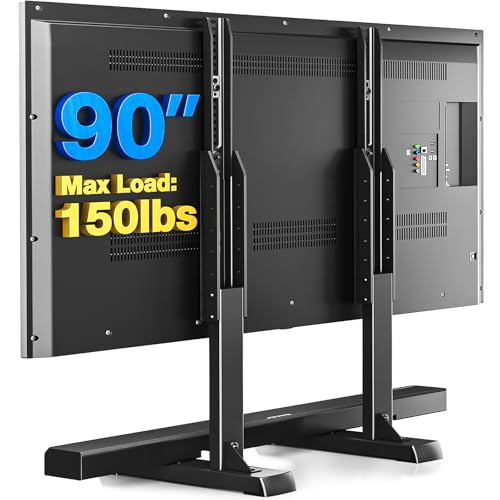
Best for: Buyers looking for a tabletop stand for a larger TV, with listed support for screens from 37 to 90 inches and weights up to 150 pounds. Its double T-shaped design uses thickened steel and a triangular support structure.
Six height settings provide up to 8.9 inches of adjustment. The feet have non-slip pads, and included cable fasteners help organize wires behind the screen. This stand stands out for its stated weight capacity and for buyers who need height adjustment without using a wall mount.
Consider: Verify both the TV’s mounting pattern and the available tabletop width; the listed screen range alone does not confirm fit for every model.
PERLESMITH Wide-Range TV Stand Legs

Best for: People replacing a TV’s original feet or adding a tabletop mounting base for a 37- to 78-inch screen. The listed maximum load is 99 pounds, and supported VESA patterns include options up to 600 × 400 mm.
The legs have nine height positions and swivel up to 30° left or right. The product information also describes installation in about 15 minutes. It is a useful choice when a wider TV-size range or larger VESA pattern is needed than some compact tabletop stands offer.
Consider: The legs need a stable, appropriately sized surface. Check that the TV’s mounting holes match one of the listed patterns and that the screen stays within the weight limit.
Hemudu Freestanding Floor TV Stand

Best for: Buyers who want a freestanding stand rather than a tabletop base or replacement legs. It is listed for most 27- to 65-inch TVs, supports up to 88 pounds, and fits VESA patterns from 100 × 100 mm to 400 × 400 mm.
The stand has four height settings and swivels up to 40° in either direction. Its design combines a steel pillar with a 10 mm tempered-glass base. Choose it if you need to place a TV independently of a media cabinet and want to adjust its viewing direction.
Consider: A floor stand needs clear floor space and a level placement area. Measure the intended location and check the base dimensions before buying.
Buying Guide: How To Choose A Non-Wall-Mount TV Stand
Should you choose a tabletop stand, replacement legs, or a floor stand?
A tabletop stand sits on a cabinet, desk, or other suitable surface and often provides height adjustment or swivel. Replacement legs are another tabletop option and can be useful when the original feet are missing or do not fit the furniture. A floor stand supports the TV independently, but it needs a stable floor area and may take up more room.
How do you check whether a stand fits your TV?
Compare three specifications before ordering: the TV’s screen-size range, its weight without exceeding the stand’s limit, and its VESA mounting pattern. VESA is the distance between the mounting holes on the back of the TV, measured horizontally and vertically in millimeters. A stand’s advertised screen size does not guarantee compatibility if the TV’s VESA pattern or weight is outside its limits.
When does swivel or height adjustment matter?
Swivel can help direct a screen toward different seats or reduce the impact of reflections from some viewing positions. Height adjustment can help position the screen or create space for equipment below it. If the TV will face one fixed seat, a simpler fixed-position stand may be sufficient; if viewing positions vary, compare the listed swivel range and adjustment steps.
What should you measure before buying?
Measure the furniture or floor area, including the space needed for the stand’s base and TV feet. Check that the stand will not overhang an unsuitable surface, and leave room for connected devices and cables. Follow the product instructions for assembly and mounting, and do not exceed the stated weight capacity.
Frequently Asked Questions
Can a non-wall-mount TV stand work with any television?
No. The TV must match the stand’s supported screen-size range, weight limit, and VESA pattern. Check all three specifications before choosing.
What is a VESA pattern?
A VESA pattern is the spacing between a TV’s mounting holes, stated in millimeters. For example, 400 × 400 mm means the holes are spaced 400 mm horizontally and 400 mm vertically.
Are floor TV stands better than tabletop stands?
Neither type is universally better. A floor stand works when you want freestanding placement, while a tabletop stand uses a cabinet or other stable surface and may have a smaller footprint in the room.
Does a swivel TV stand rotate the entire base?
Swivel range varies by model. The products described here specify rotation at the TV mount, with listed ranges from 50° total to 80° total. Check each product’s details for how its swivel is measured.
Can a TV stand hold a soundbar?
Some stands may leave room below the screen, but fit depends on the stand’s height settings and the dimensions of the soundbar. Measure the available space rather than assuming that a soundbar will fit.