Best Office Chairs With Pivoting Armrests for Flexible Workspaces
The best office chair with pivoting armrests depends on how you sit and how much adjustability you need. The Dowinx is best for cross-legged sitting and reclining, while the FiveWillowise adds a footrest and lockable recline. For conventional desk work, the Synorla offers flip-up arms, and the MOLENTS and HOLLUDLE provide adjustable 3D armrests. Compare arm movement, lumbar support, recline, and seat style before choosing.
| Chair | Armrest style | Best for |
|---|---|---|
| Dowinx Cross Legged | 180-degree pivoting and lockable | Cross-legged sitting and reclining |
| FiveWillowise Criss Cross | 180-degree pivoting and lockable | Wide seating with a footrest |
| Synorla Ergonomic Mesh | 90-degree flip-up | Compact spaces and standard desk work |
| MOLENTS Ergonomic Mesh | 3D adjustable | Fine-tuning arm support |
| HOLLUDLE Ergonomic Mesh | 3D adjustable | Multiple posture adjustments |
Dowinx Cross-Legged Chair
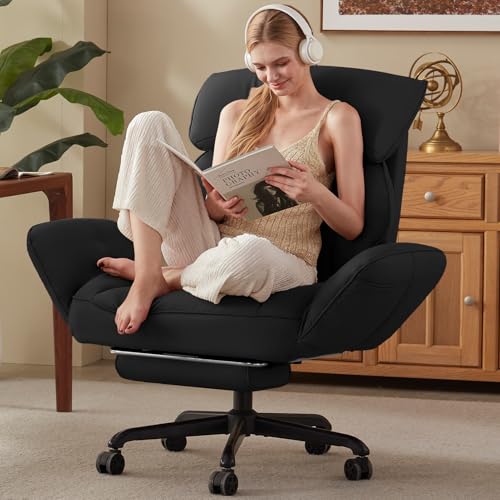
This Dowinx chair is best for people who want room to sit cross-legged or change positions during work. Its armrests pivot up to 180 degrees and lock in multiple positions, so they can be moved aside when more seat space is useful. The seat and backrest contain independent pocket springs, and the backrest reclines from 90 to 135 degrees.
Choose this model if adjustable arm placement and a reclining seat matter more than a conventional mesh-office-chair design. The pocket-spring construction is intended to provide cushioning and support across the seat and back. One limitation: the listed features do not specify detailed lumbar adjustment or a weight capacity, so check the product listing for those details if they are essential.
FiveWillowise Criss Cross Chair

The FiveWillowise is best for buyers seeking a wide, cushioned chair with pivoting arms and a built-in footrest. Its armrests pivot up to 180 degrees and lock in different positions, creating more room for cross-legged sitting or movement. The chair has a hidden footrest and a backrest that reclines from 90 to 135 degrees and can lock in position.
Its seat and back use foam and pocket springs, and the feature description highlights added padding in the armrests. Choose it if you want to combine flexible arm placement with a footrest for breaks. Avoid choosing it solely for fine-grained ergonomic adjustment: the supplied details do not describe adjustable lumbar support or a mesh back.
Synorla Flip-Up Arm Mesh Chair

This Synorla chair is best for a home office or study area where the chair needs to tuck under a desk. Its padded armrests flip up 90 degrees, and the product description says this space-saving design makes it easier to move the chair under a desk. Other listed features include spine-shaped back support, lumbar support, four inches of seat-height adjustment, and a backrest that tilts up to 135 degrees.
Choose it if you prefer a conventional mesh task chair over a wide cross-legged seat. A key limitation is that the recline does not lock: the chair rocks back but returns upright automatically. Its arms flip up rather than offering the 180-degree pivot and multiple locking positions found on the cross-legged models.
MOLENTS 3D Armrest Mesh Chair

The MOLENTS is best for buyers who want to adjust arm support rather than simply swing the arms out of the way. Its 3D armrests are designed to move in multiple directions for a more tailored position. The chair also has adjustable lumbar support that moves up and down and forward and backward, plus breathable, high-elastic mesh.
Choose this model if arm and lower-back positioning are priorities for desk work. Its mesh construction is intended to support airflow during extended sitting. The supplied features do not state the exact adjustment range for the armrests or describe a reclining angle, so compare the listing details if you need specific movement limits or recline settings.
HOLLUDLE Adjustable Mesh Chair

The HOLLUDLE is best for buyers who want several adjustment options in a mesh chair. Its 3D armrests adjust in height, move forward and backward, and rotate. The chair also includes 3D lumbar support that can move up, down, forward, and backward and rotate. A two-dimensional headrest and three-level tilt lock add further positioning options.
Choose it if you want to fine-tune arm, head, and lumbar positions for work, gaming, or relaxation. The V-shaped back gives it a distinct appearance compared with the simpler mesh styles listed here. Its armrests are adjustable, but the listed description does not say they pivot 180 degrees or flip up to clear the desk.
Buying Guide: How to Choose a Chair With Pivoting Armrests
Do you need arms that pivot, flip up, or adjust in 3D?
These terms describe different functions. A 180-degree pivoting armrest can rotate out of the way and, on the Dowinx and FiveWillowise models, lock in multiple positions. A flip-up armrest moves upward to help the chair fit under a desk. A 3D armrest adjusts in several directions for arm placement, but does not necessarily fold away. Choose based on whether you need more seat space, desk clearance, or customized support.
What chair style suits your sitting position?
Cross-legged chairs provide a wider seating approach for people who like to change leg positions. Traditional mesh task chairs are a better fit if you want a more conventional desk-chair shape and features such as adjustable lumbar support. Check the seat dimensions and other specifications in the product listing; the supplied information does not provide a consistent size comparison across these models.
Which comfort and recline features matter?
Compare the support features you will use regularly. Pocket springs are listed for the Dowinx and FiveWillowise models, while the Synorla, MOLENTS, and HOLLUDLE are described as mesh chairs. For reclining, distinguish between a stated angle range and a lockable position: the Synorla tilts up to 135 degrees but is described as returning upright, while FiveWillowise lists a lockable recline.
What should you verify before ordering?
Review the complete listing for dimensions, assembly requirements, weight capacity, and any adjustment details important to your workspace. Those specifications are not provided consistently in the product information here. Also consider desk height and how far the chair needs to tuck beneath it; flip-up arms may help with clearance, while pivoting arms are useful when you want to open up the seat area.
Frequently Asked Questions
What does a 180-degree pivoting armrest do?
It rotates around its attachment point through a wide range of positions. On the listed Dowinx and FiveWillowise chairs, the arms can be positioned or stowed to create more space, and the features say they lock in place.
Are pivoting armrests the same as flip-up armrests?
No. Pivoting arms rotate outward or into different positions, while flip-up arms move upward. Both can help create clearance, but their movement and use differ.
Which chair is best for sitting cross-legged?
The Dowinx and FiveWillowise are explicitly described as criss-cross or cross-legged chairs and have armrests that pivot out of the way. The FiveWillowise also lists a built-in footrest.
Which option has the most detailed lumbar adjustment?
The HOLLUDLE lists 3D lumbar support that moves up, down, forward, and backward and rotates. The MOLENTS also lists lumbar adjustment in two directions: up and down, and forward and backward.
Can every chair in this list lock in a reclined position?
No. The FiveWillowise description says its recline is lockable. The Synorla description specifically says its backrest tilts but does not lock in a reclined position. Recline-lock details are not specified for every model.